What is fusion?
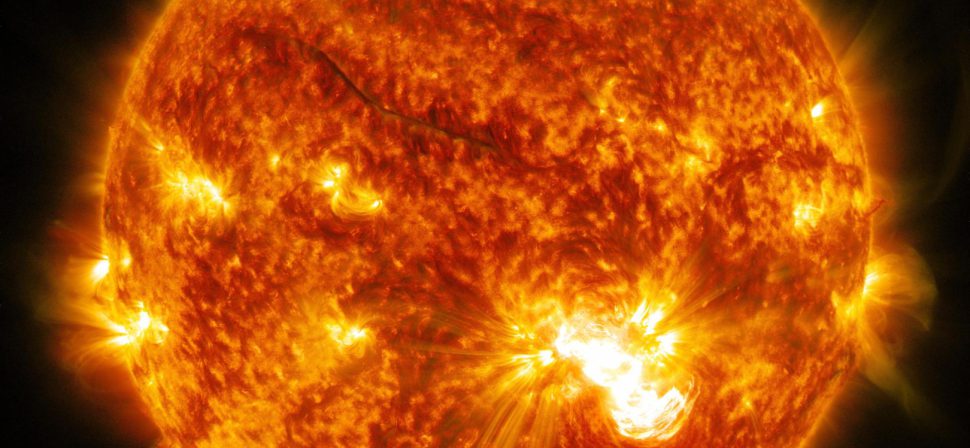
Nuclear fusion occurs naturally in stars, like our sun. When hydrogen gets hot enough, hydrogen nuclei collide and fuse into heavier helium atoms, releasing energy.
On earth, producing fusion reactions by heating, compressing, and confining hydrogen plasmas at the required temperatures of 100 million degrees or more involves significant challenges.
Solving these challenges creates a path for fusion to provide clean, abundant, safe energy. The fusion process produces no greenhouse gas emissions and generates no high-level radioactive waste. It is fueled by available resources: Deuterium (heavy hydrogen) is plentiful in water and tritium can be produced during the fusion process.
ITER will allow scientists to explore the physics of a burning plasma at energy densities close to that of a commercial power plant. This is a critical step toward producing and delivering electricity from fusion to the grid as part of the United States’ long-term energy plans.
Science and engineering reports and statements on fusion and ITER
- National Academies of Science and Engineering, Bringing Fusion to the U.S. Grid (2021): “U.S. fusion and related industries benefit from the technologies, know-how, and experience that results from U.S. engagement in ITER. Leveraging the experience gained from the ITER project will be important to meeting the aggressive time scale for a pilot plant.”
- Department of Energy Fusion Energy Sciences Advisory Committee, Powering the Future – Fusion and Plasmas. A long-range plan to deliver fusion energy and advance plasma science (2021): “A sustained burning plasma at high power density is required simultaneously with a solution to the power exhaust challenge: mitigating the extreme heat fluxes to materials surrounding the plasma. U.S. partnership in ITER provides access to a high-gain reactor-scale burning fusion plasma and an accompanying US ITER research team and program to exploit this facility must be developed.”
- National Academies for Science and Engineering, A Strategic Plan for U.S. Burning Plasma Research (2018): “The United States should remain an ITER partner as the most cost-effective way to gain experience with a burning plasma at a scale of a power plant….The United States should start a national program of accompanying research and technology leading to the construction of a compact pilot plant that produces electricity from fusion at the lowest possible capital cost.”
- National Research Council. Burning Plasma: Bringing a Star to Earth (2004): “A burning plasma experiment is the crucial next step…[and] the next scientific frontier in the quest for magnetic fusion energy…The tokamak configuration is scientifically and technically ready for a high gain burning plasma experiment.”
- American Nuclear Society: “The American Nuclear Society (ANS) supports a vigorous research and development program for fusion energy.” | position statement
- National Academy for Engineering. NAE identified “Providing Energy From Fusion” as one of the grand challenges for engineering in the 21st century.
- IEEE (Institute of Electrical and Electronics Engineers, Inc.)-USA notes the need for supporting fundamental R&D in industry, academia and government to continue exercising world leadership in nuclear fission and fusion science. | position statement
Related Fact Sheets