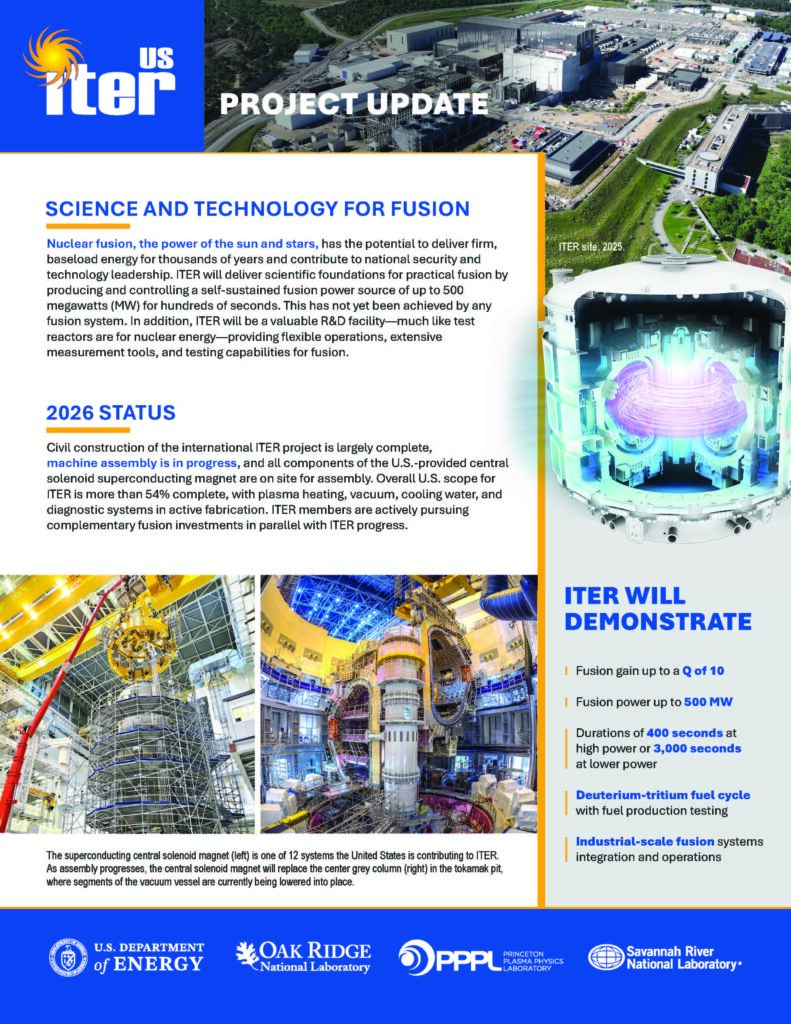
ITER will demonstrate the production and control of a sustained fusion power source for hundreds of seconds at power-plant relevant scale. Public and private fusion sectors agree that this is an essential step to establish the scientific basis for practical fusion energy and the development of first-of-a-kind fusion technologies. The ITER project crosscuts the nation’s fusion goals for research, technology development, and a path to practical fusion energy.
The United States, whose contributions are managed by the US ITER Project Office at Oak Ridge National Laboratory for the Energy Department, is contributing 12 technical systems to ITER. Two of these systems, the toroidal field conductor and the steady state electrical network, are complete. The six superconducting magnet modules for the “heart of ITER,” the central solenoid, have been delivered to the ITER site, with five are stacked for assembly. With the nation’s contributions 54 percent complete, U.S. industry continues to support design, manufacture, and delivery of US ITER hardware.
Fact sheets:
Project Update (February 2026)